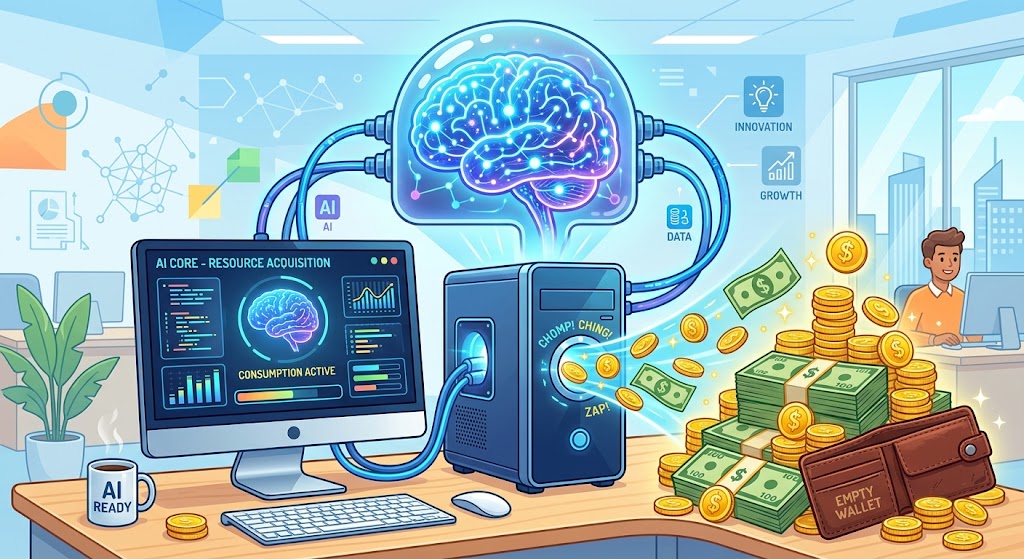
Running local AI is far from free - it shifts the invoice from a cloud vendor to your balance sheet.
Between high-end GPU based systems, surging electricity and cooling bills, server maintenance, and the specialized engineering talent required to keep inference pipelines optimized, self-hosting carries in real life massive capital and operational expenses.
Metering and billing internal teams by the token is essential: it creates accountability against wasteful compute loops and directly amortizes those upfront infrastructure, pipelines, and staffing investments.
So how to measure and bill AI tokens in a small AI Lab?
This is a tricky architectural and engineering challenge with a lot of tradeoffs, ideal EDU AI LAB material.
Here I share minimal setups distilled from the larger ones I use in enterprise workshops, to demonstrate the complexity of local AI inference engineering in practice and the role of caching.
Tokenomics - cost is more than just tokens. It spans hardware and power, pipeline complexity, observability (can you find and debug it?), reproducibility, and manageability. Every form of spend needs to be metered at the end.
CC (Contrast & Compare) - in AI there is always more than one way to do things. A controlled environment with enough complexity lets you pick and test approaches, finding the right fit across tradeoffs and levels of integration. The EDU AI LAB contrasts and compares three inference engines on the same small ~3B model: llama.cpp, vLLM, and SGLang.
Agentic Infrastructure - the AI evolution beyond IaaS: agents and harnesses are directly exposed to infrastructure through MCP servers and skills following dynamic rules (not fixed templates), turning infra access into governed, tool-based operations.
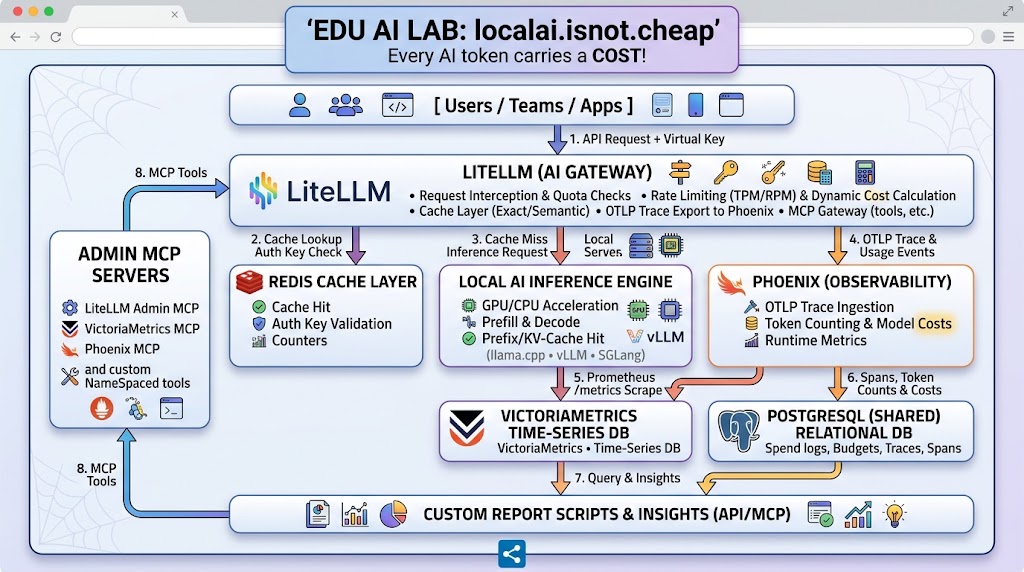
Architecture - LiteLLM meter-and-bill gateway in front of local engines, with Redis caching, Phoenix observability, VictoriaMetrics metrics, and shared PostgreSQL under one roof.
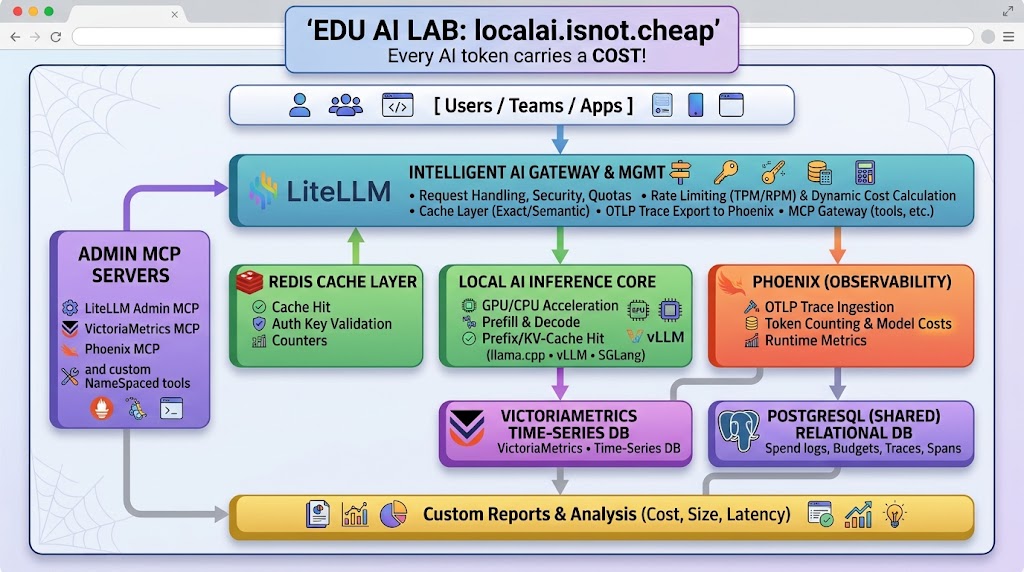
How it works - Every token carries a cost so we cache wherever we can!!!
Mission - inference engineering is emerging as its own specialization. Just like you cannot learn programming by watching videos, you cannot learn this field from tutorials alone: you need infrastructure you can touch, feel, and explore, where tradeoffs and side effects show up for real. The EDU AI LAB is a single node, but it is Docker-container based — everything runs in containers on one machine — and it still carries enough complexity to demonstrate most inference-engineering principles from a systems-thinking perspective - turning reading into practice and letting you safely explore the tradeoffs of the field. You get the idea. Local AI is not CHEAP (GitHub Repository)
Deep dive materials about Inference Engineering - for self-study.
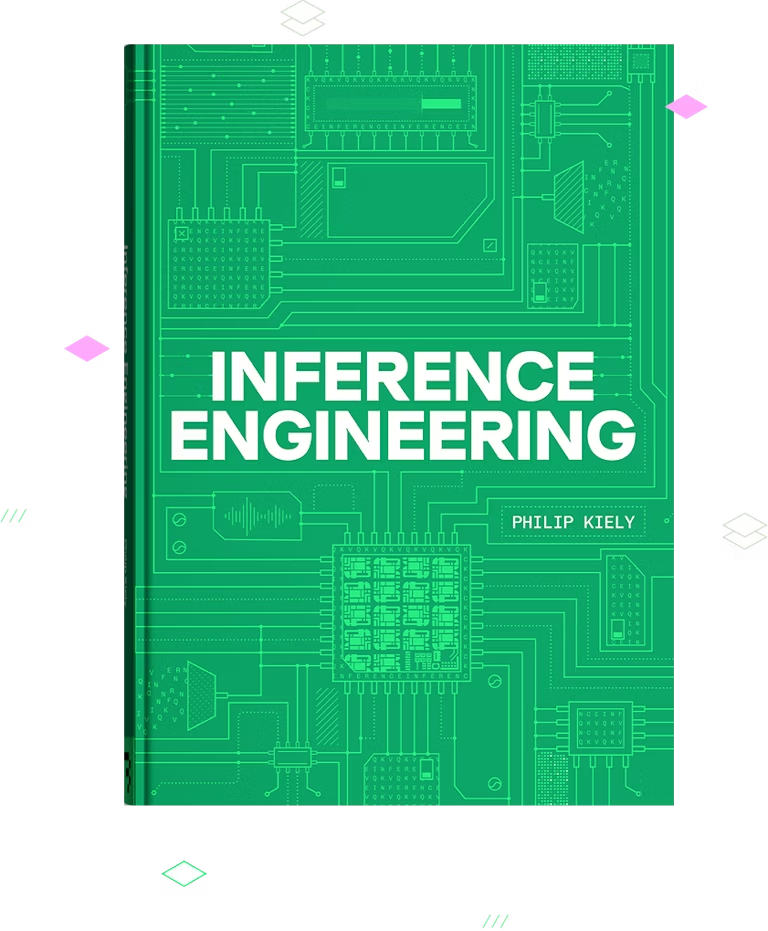
Inference Engineering - by Philip Kiely (Baseten). Now in its 3rd edition and free as a PDF.
A book for engineers who want to understand the technologies that power every AI company and application in the world.
Covers the inference stack end to end - GPU kernels and the memory wall, KV-cache and prefix caching, quantization, batching, and serving in production - the same tradeoffs the EDU AI LAB demonstrates live.
What is Prompt Caching? Optimize LLM Latency with AI Transformers
How KV Cache Speeds Up LLMs for Faster AI Models on GPUs
Llama.cpp vs vLLM - Which Local LLM Engine Actually Scales?
SGLang vs vLLM - Which LLM Inference Framework Should You Use?
First Principles
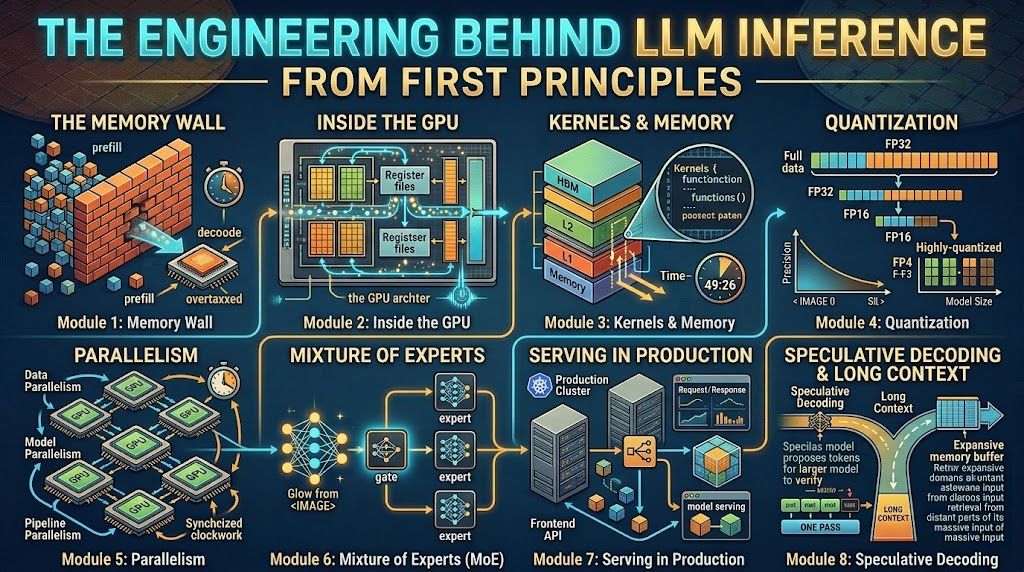
The Engineering Behind LLM Inference - From First Principles
Must-study before serving any AI model to really grasp the tradeoffs.
PY (@thecommitlog) has excellent deep-dive videos (with sources) which can help you better understand the tradeoffs in Inference Engineering - they are great companions to the book by Philip Kiely.
The Engineering Behind LLM Inference From First Principles - YouTube playlist:
Agentic Infrastructure
How will your future job look?
Infrastructure as Agents - Autonomous AI Agents behind your Infrastructure as Code!